


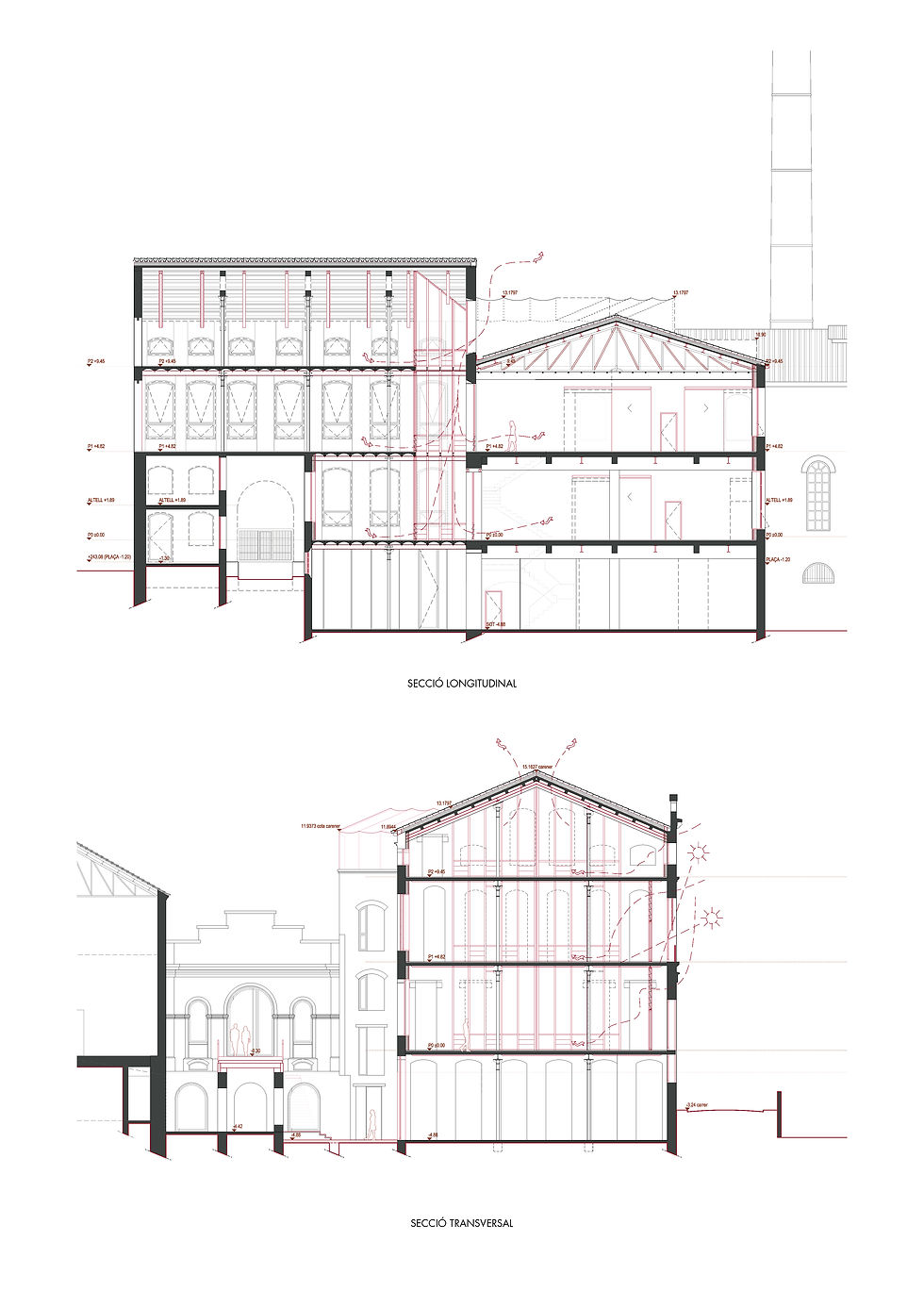
Documentació Prèvia | Previous Documentation
Arquitecta | Architect: Meritxell Inaraja i Genís
Superfície construïda | Gross floor area: 2.632,29 m²
Protecció | Building protection: BCIL (Bé Cultural d'Interès Local)
Any | Date: 2024 - 2025
Fotografia | Photography: Adrià Goula
Premis | Awards
PREMIS FAD 2026:
OBRA FINALISTA
Des del seu origen el 1894 i segons el projecte d’Ignasi Oms i Ponsa, la fàbrica d’electricitat de l’Anònima Manresana ja tenia una situació central en el barri antic de Manresa que facilitava la distribució d’electricitat que produïa. Actualment, la seva rehabilitació per a un nou ús busca recuperar aquest llegat històric revivint-la com a equipament públic que reactivi i revitalitzi el barri antic.
L’edifici originalment es trobava inserit en la trama urbana amb edificacions adjacents que ara han estat enderrocades selectivament per guanyar nous espais urbans lliures. El formen tres naus: la pròxima al carrer, fàbrica tèxtil que aprofitava els excedents elèctrics, i dues naus paral·leles que acollien les calderes i la maquinària. Als soterranis s’hi ubicaven carboneres i conductes de fums fins a la gran xemeneia.La nau més gran es manté diàfana per a espectacles i activitats polivalents i no forma part de l’actuació, mentre que la nau central es transforma en vestíbul públic i les tres plantes de l’antiga fàbrica tèxtil en oficines municipals.
La proposta reconeix la memòria històrica, arquitectònica i social de l’edifici i el fa capaç d’acollir nous usos sense perdre la seva identitat. La intervenció es concep com un empelt entre l’històric i el contemporani que en garanteix la continuïtat. El diàleg entre èpoques potencia el seu valor transformador tant a escala arquitectònica i urbana com social.
Inicialment, només centrada en la rehabilitació interior, la intervenció va trobar en el deteriorament del soterrani sota la plaça una oportunitat per a generar noves relacions, i anant més enllà de la simple recuperació de l’edifici original, el buidat d’aquests espais malmesos ha permès noves connexions urbanes i obrir els soterranis a la llum i a l’espai públic. Així, una limitació s’ha transformat en un valor afegit, millorant no només les condicions de l’edifici sinó també les de l’espai públic.
La conservació de les façanes i la memòria dels espais interiors originals són els pilars inicials de la proposta, que ve guiada i es reforça per l’estratègia energètica passiva aplicada a la rehabilitació, que és la que defineix i organitza l’espai. La formació d’una doble façana a manera de galeria vidriada actua com a element intermedi que proporciona ombra i ventilació a l’estiu, i calor i assolellament a l’hivern, deixant intacte l’aspecte interior dels tancaments.
L’obertura d’un espai central a tota alçada funciona com a xemeneia de ventilació vertical que reforça la ventilació creuada i ofereix relació visual i llum natural a totes les plantes, i ha permès visibilitzar i posar en valor una façana interior històrica que havia quedat amagada. L’estratègia energètica aplicada no és només funcional, sinó també sensorial i visual i afavoreix una lectura renovada i unitària de l’Anònima i el seu entorn.
També la necessària formació d’un badalot d’ascensor que garanteix l’accessibilitat es planteja com un assaig de reinterpretació contemporània de sistemes constructius històrics que dona continuïtat diferenciada, però harmònica a les façanes i que serà aplicable a futures ampliacions.
Since its origins in 1894, designed by the architect Ignasi Oms i Ponsa, the Anònima Manresana power plant occupied an strategic position within Manresa’s historic center, facilitating the distribution of the electricity it generated. Today, its rehabilitation for a new use seeks to recover this historical legacy by reviving the building as a public facility capable of reactivating and revitalising the old town.
Originally embedded within a dense urban fabric and flanked by adjoining buildings, the structure has been selectively freed through the demolition of adjacent constructions, creating new public open spaces. The complex consists of three volumes: the street-facing building, formerly a textile factory that utilised surplus electricity, and two parallel halls that housed the boilers and machinery. The basement levels accommodated coal storage areas and smoke ducts connected to the large chimney. While the largest hall remains an open, unobstructed space intended for performances and multipurpose activities and lies outside the scope of this intervention, the central hall has been transformed into a public foyer, and the three storeys of the former textile factory now accommodate municipal offices.
The proposal acknowledges the building’s historical, architectural and social memory while enabling it to accommodate new uses without losing its identity. The intervention is conceived as a graft between the historic and the contemporary, ensuring continuity through transformation. This dialogue between different periods enhances the building’s transformative potential at architectural, urban and social scales.
Initially focused solely on the interior rehabilitation, the project found in the deterioration of the basement beneath the square an opportunity to establish new relationships. Moving beyond the simple restoration of the original building, the excavation of these damaged spaces has enabled new urban connections and opened the basements to daylight and public space. In this way, a limitation has been transformed into an asset, improving not only the building itself but also the quality of the surrounding public realm.
The preservation of the façades and the memory of the original interior spaces constitute the project’s primary foundations. These are reinforced and guided by the passive environmental strategy applied throughout the rehabilitation, which ultimately defines and organises the spatial experience. The introduction of a double-skin façade in the form of a glazed gallery acts as an intermediate climatic buffer, providing shade and natural ventilation in summer while capturing solar gain and warmth in winter, all while preserving the original appearance of the interior enclosure.
A new full-height central void functions as a vertical ventilation chimney, strengthening cross-ventilation while providing visual connections and natural light to all floors. It has also revealed and brought into prominence a historic internal façade that had remained hidden for decades. The environmental strategy is therefore not merely functional, but also sensory and spatial, fostering a renewed and unified reading of the Anònima and its surroundings.
The new lift tower, required to ensure accessibility, is likewise conceived as an exploration of the contemporary reinterpretation of historic construction systems. It provides a distinct yet harmonious continuation of the existing façades and establishes a language that can be extended to future additions and expansions.


REHABILITACIÓ DE L'ANTIGA ANÒNIMA MANRESANA (1894)
MANRESA
(Bages - Barcelona)
2025